Categories

Biology explores life’s incredible diversity, from microscopic organisms to complex ecosystems, and its fundamental principles are crucial for understanding our world.
Biology, at its core, is the scientific study of life. This encompasses an incredibly broad range of topics, from the molecular mechanisms within cells to the global interactions of entire ecosystems. It seeks to describe, explain, and predict the natural phenomena pertaining to living organisms.
Essentially, biologists investigate how life works – how organisms are structured, how they grow, reproduce, evolve, and interact with their environment. Key areas include biochemistry, genetics, ecology, and evolution. Understanding biological principles is vital not only for scientific advancement but also for addressing critical global challenges like disease, food security, and environmental conservation.
The field utilizes the scientific method to test hypotheses and build a robust understanding of the living world, constantly refining our knowledge through observation and experimentation.
Living organisms share several key characteristics that distinguish them from non-living matter. These include organization – being composed of cells, the basic units of life. They exhibit metabolism, utilizing energy and undergoing chemical reactions. Growth and development are also crucial, alongside the ability to reproduce, creating new organisms.
Furthermore, living things demonstrate responsiveness to their environment, maintaining homeostasis (a stable internal environment), and adaptation through evolution. Genetic material, in the form of DNA, provides the instructions for these processes.
It’s important to note that not every entity displays all characteristics simultaneously, but collectively, these traits define life as we know it. Recognizing these features is fundamental to understanding biological systems.
The scientific method is a systematic approach to understanding the natural world. It begins with an observation, leading to a testable hypothesis. A well-designed experiment is then conducted, manipulating an independent variable and measuring the dependent variable.
Crucially, experiments require control groups for comparison and should minimize bias. Data collected is then analyzed, and conclusions are drawn based on the evidence. Replication of results is vital for validity.
Proper experimental design includes clearly defined variables, adequate sample sizes, and appropriate controls. Understanding these principles is essential for interpreting biological research and conducting sound investigations.

Biochemistry unveils life’s molecular basis, exploring the chemical processes within and relating to living organisms, forming the foundation of biological functions.
Atoms, the basic units of matter, combine through chemical bonds to form molecules, essential for life’s processes. Understanding atomic structure – protons, neutrons, and electrons – is key.
Ionic bonds involve electron transfer, creating ions with opposite charges that attract. Covalent bonds share electrons between atoms, forming strong, stable connections. Hydrogen bonds, weaker interactions, are vital for water’s properties and protein structure.
Polarity arises when electrons are unevenly shared, creating partial charges. Water’s polarity allows it to form hydrogen bonds, influencing its solvent capabilities and biological roles. Recognizing these bond types and their strengths is fundamental to comprehending biochemical interactions and molecular behavior within living systems.
Water is the most abundant molecule in living organisms, crucial for life as we know it. Its unique properties stem from its polarity and hydrogen bonding. Cohesion, the attraction between water molecules, creates surface tension and aids in transport.
Adhesion, attraction to other surfaces, contributes to capillary action in plants. Water’s high specific heat capacity stabilizes temperatures, protecting organisms from drastic fluctuations. Its high heat of vaporization provides cooling through evaporation.
Water is an excellent solvent, dissolving many substances essential for biochemical reactions. These properties make water indispensable for nutrient transport, waste removal, temperature regulation, and maintaining cellular structure – fundamentally supporting all life processes.

Living organisms are built upon four major classes of organic biomolecules: carbohydrates, lipids, proteins, and nucleic acids. Each plays a distinct and vital role. Carbohydrates provide energy and structural support, while lipids store energy, form cell membranes, and act as hormones.
Proteins are the workhorses of the cell, performing a vast array of functions – enzymes, structural components, transport, and defense. Finally, nucleic acids (DNA and RNA) store and transmit genetic information, directing all cellular activities.
Understanding the structure and function of these biomolecules is fundamental to comprehending life’s processes. Their interactions and coordinated activities are essential for maintaining life’s complexity and enabling organisms to thrive.
Carbohydrates, composed of carbon, hydrogen, and oxygen, are essential for life, primarily serving as a quick source of energy. They exist as monosaccharides (like glucose and fructose), disaccharides (like sucrose), and polysaccharides (like starch, glycogen, and cellulose).
Monosaccharides are the building blocks, while polysaccharides are long chains used for energy storage (starch in plants, glycogen in animals) or structural support (cellulose in plant cell walls). The arrangement of these sugars dictates their function.
Understanding carbohydrate structure is key to understanding metabolic pathways. They are readily broken down through cellular respiration to fuel cellular activities, making them vital for all living organisms.
Lipids are a diverse group of hydrophobic molecules, crucial for energy storage, structural components of cell membranes, and signaling. Key types include triglycerides (fats and oils), phospholipids, steroids, and waxes.
Triglycerides efficiently store energy, while phospholipids form the bilayer of cell membranes, controlling what enters and exits cells. Steroids, like cholesterol, serve as hormones and membrane components.
Lipids are built from glycerol and fatty acids. Saturated fats have no double bonds, are solid at room temperature, and unsaturated fats have double bonds, are liquid. Understanding lipid structure is vital for comprehending cell membrane function and energy metabolism.
Proteins are the workhorses of the cell, performing a vast array of functions including enzymatic catalysis, structural support, transport, and cellular communication. They are polymers of amino acids linked by peptide bonds.
Protein structure has four levels: primary (amino acid sequence), secondary (alpha helices and beta sheets), tertiary (3D folding), and quaternary (multiple polypeptide chains). This structure dictates function.
Enzymes, a type of protein, speed up biochemical reactions. Denaturation – the unfolding of a protein – can occur due to changes in pH, temperature, or salinity, leading to loss of function. Understanding protein structure is key to understanding biological processes.

Nucleic acids – DNA and RNA – store and transmit genetic information. They are polymers of nucleotides, each composed of a sugar, phosphate group, and nitrogenous base.
DNA, a double helix, contains the genetic blueprint. Its bases are adenine (A), guanine (G), cytosine (C), and thymine (T), pairing A with T and C with G. RNA, typically single-stranded, uses uracil (U) instead of thymine.
DNA’s primary function is long-term information storage, while RNA plays roles in gene expression – transferring genetic code from the nucleus to ribosomes for protein synthesis. Understanding nucleic acid structure is fundamental to understanding heredity.

Cells, life’s basic units, exhibit diverse structures. Organelles within cells perform specific functions, enabling life processes and maintaining cellular homeostasis effectively.
Prokaryotic cells, like bacteria and archaea, are simpler and lack a nucleus or other membrane-bound organelles. Their DNA resides in a nucleoid region. These cells are generally smaller and reproduce through binary fission. Eukaryotic cells, found in plants, animals, fungi, and protists, are more complex.
They do possess a true nucleus housing their DNA, alongside various organelles like mitochondria, endoplasmic reticulum, and Golgi apparatus, each with specialized functions. Eukaryotic cells are typically larger and can reproduce sexually or asexually through mitosis and meiosis. A key difference lies in cellular organization; prokaryotes lack internal compartmentalization, while eukaryotes exhibit it.
Understanding these distinctions is fundamental to comprehending the diversity of life and the evolutionary relationships between organisms. Consider size, complexity, and the presence of a nucleus when comparing these cell types.
Cell organelles are specialized subunits within a cell, each performing a specific function. The nucleus controls cellular activities, housing DNA. Ribosomes synthesize proteins. Mitochondria generate energy through cellular respiration, often called the “powerhouse” of the cell.
Chloroplasts (in plant cells) conduct photosynthesis, converting light energy into chemical energy. The endoplasmic reticulum (ER) transports and processes molecules; rough ER has ribosomes, while smooth ER does not. The Golgi apparatus modifies, sorts, and packages proteins and lipids.
Lysosomes break down waste materials, and vacuoles store water and nutrients. The cell membrane regulates what enters and exits. These organelles work together harmoniously to maintain cell life and function, demonstrating incredible cellular coordination.
The nucleus is the control center of the eukaryotic cell, enclosed by a double membrane called the nuclear envelope. Within the nucleus resides DNA, the genetic blueprint of the organism, organized into chromosomes. DNA contains the instructions for building proteins and regulating cellular processes.
Chromatin, a complex of DNA and proteins, condenses into visible chromosomes during cell division. The nucleolus, found inside the nucleus, is responsible for ribosome synthesis. DNA replication ensures accurate duplication of genetic material before cell division, preserving genetic information.
Understanding the nucleus and DNA is fundamental to understanding heredity, gene expression, and the overall functioning of the cell. Mutations in DNA can lead to genetic variations and diseases, highlighting its critical role in life.
Ribosomes are cellular structures responsible for protein synthesis, a vital process for all living organisms. They are found free-floating in the cytoplasm or bound to the endoplasmic reticulum (ER). Ribosomes read the genetic code carried by messenger RNA (mRNA) and use this information to assemble amino acids into polypeptide chains.
Transfer RNA (tRNA) delivers the correct amino acids to the ribosome, matching them to the mRNA codons. This process, called translation, results in the creation of a specific protein. Proteins perform a vast array of functions within the cell, including enzymatic catalysis, structural support, and transport.
The efficiency and accuracy of ribosome function are crucial for cellular health. Errors in protein synthesis can lead to non-functional proteins and cellular dysfunction.
Mitochondria are often called the “powerhouses of the cell” because they are the primary sites of cellular respiration. These double-membraned organelles generate adenosine triphosphate (ATP), the cell’s main energy currency, from the breakdown of glucose and other fuel molecules.
Cellular respiration involves a series of metabolic pathways, including glycolysis, the Krebs cycle (citric acid cycle), and the electron transport chain (ETC). The ETC, located within the inner mitochondrial membrane, utilizes oxygen to produce a large amount of ATP.
Mitochondria possess their own DNA and ribosomes, suggesting an evolutionary origin from ancient bacteria. Their function is essential for providing the energy needed for all cellular activities, from muscle contraction to nerve impulse transmission.
Chloroplasts are the organelles responsible for photosynthesis, the process by which plants and other organisms convert light energy into chemical energy in the form of glucose. These organelles contain chlorophyll, a green pigment that absorbs sunlight.
Photosynthesis occurs in two main stages: the light-dependent reactions and the light-independent reactions (Calvin cycle). Light-dependent reactions capture light energy and convert it into ATP and NADPH. The Calvin cycle uses ATP and NADPH to fix carbon dioxide and produce glucose.
Like mitochondria, chloroplasts have their own DNA and ribosomes, supporting the endosymbiotic theory. Photosynthesis is vital for life on Earth, providing oxygen and the foundation of most food chains.
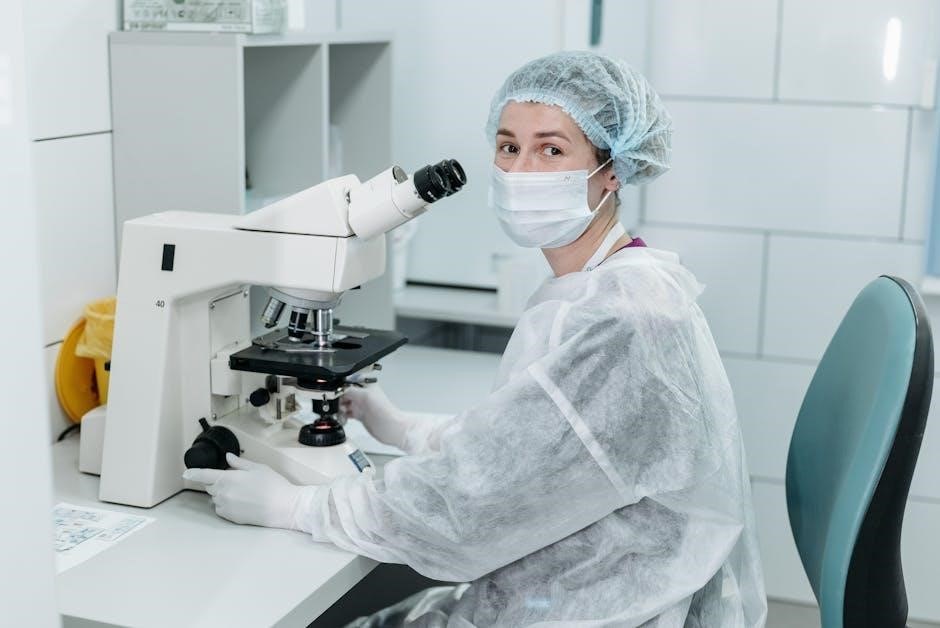
Cellular processes encompass vital functions like transport, respiration, and photosynthesis, enabling cells to maintain life and perform specialized tasks efficiently.
The cell membrane, a phospholipid bilayer with embedded proteins, regulates what enters and exits the cell, maintaining homeostasis. Passive transport – diffusion and osmosis – requires no energy, moving substances down their concentration gradients.
Diffusion is the movement of particles from high to low concentration, while osmosis specifically concerns water movement across a semi-permeable membrane. Active transport, however, requires energy (ATP) to move substances against their concentration gradients, often utilizing protein pumps.
Endocytosis and exocytosis are bulk transport mechanisms. Endocytosis brings materials into the cell via vesicle formation, while exocytosis releases materials from the cell. Understanding these transport methods is key to grasping cellular function and communication.
Cellular respiration breaks down glucose to generate ATP, the cell’s energy currency. It begins with glycolysis in the cytoplasm, yielding a small amount of ATP and pyruvate.
Pyruvate then enters the mitochondria for the Krebs cycle (Citric Acid Cycle), producing more ATP, NADH, and FADH2. These electron carriers deliver electrons to the Electron Transport Chain (ETC).
The ETC, located in the mitochondrial membrane, uses electron energy to pump protons, creating a gradient that drives ATP synthase to produce a large amount of ATP via oxidative phosphorylation. Oxygen is the final electron acceptor, forming water. Understanding each stage and its ATP yield is crucial.
Photosynthesis converts light energy into chemical energy in the form of glucose. It occurs in two main stages: the light-dependent reactions and the light-independent reactions (Calvin Cycle).
Light-dependent reactions, taking place in the thylakoid membranes, capture light energy to produce ATP and NADPH. Water is split, releasing oxygen as a byproduct.
The Calvin Cycle, occurring in the stroma, uses the ATP and NADPH from the light-dependent reactions to fix carbon dioxide into glucose. This process involves carbon fixation, reduction, and regeneration of the CO2 acceptor. Knowing the inputs and outputs of each stage is vital for understanding energy flow.

Genetics examines how traits are inherited, focusing on DNA, genes, and their expression, shaping the diversity of life through generations.
DNA, or deoxyribonucleic acid, is the blueprint of life, structured as a double helix composed of nucleotides – adenine (A), thymine (T), guanine (G), and cytosine (C). These base pairs connect via hydrogen bonds (A with T, and G with C), forming the ‘rungs’ of the DNA ‘ladder’. The sugar-phosphate backbone provides structural support.
Replication is the process of creating an identical copy of DNA. It begins with unwinding the double helix, then enzymes, like DNA polymerase, add complementary nucleotides to each strand, resulting in two identical DNA molecules. This semi-conservative replication ensures genetic information is accurately passed on during cell division. Understanding the enzyme roles and base-pairing rules is key!
Errors during replication are rare but can lead to mutations, which are changes in the DNA sequence. These mutations can be beneficial, harmful, or neutral.
Gene expression is the process by which information encoded in DNA is used to direct the assembly of proteins. It involves two main stages: transcription and translation.
Transcription occurs in the nucleus, where DNA is copied into messenger RNA (mRNA). RNA polymerase reads the DNA sequence and creates a complementary mRNA strand. This mRNA then travels to the ribosomes.
Translation takes place in the ribosomes, where the mRNA sequence is decoded to build a protein. Transfer RNA (tRNA) molecules bring specific amino acids to the ribosome, matching them to the mRNA codons (three-nucleotide sequences). These amino acids are linked together to form a polypeptide chain, which folds into a functional protein. Understanding codon charts is vital!
Mendelian genetics, based on Gregor Mendel’s work, explains how traits are passed from parents to offspring. Key concepts include genes, alleles (dominant and recessive), and segregation – the separation of alleles during gamete formation.
Inheritance patterns describe how these traits are expressed. Dominant alleles mask recessive ones, meaning only one copy is needed for the trait to appear. Recessive alleles require two copies.
Genotype refers to the allele combination, while phenotype is the observable trait. Homozygous individuals have two identical alleles, and heterozygous individuals have two different alleles. Mastering these terms is crucial for predicting offspring traits using tools like Punnett squares.
Punnett squares are diagrams used to predict the probability of offspring inheriting specific traits. They visually represent the possible combinations of alleles from parents. By placing parental genotypes along the top and side of the square, you can fill in the resulting genotypes of the offspring.
Each box within the square represents a potential genotype, and the frequency of each genotype indicates the probability of it occurring. Understanding probability is key – a 50% chance means roughly half the offspring will exhibit that genotype.
These squares help determine the likelihood of homozygous dominant, heterozygous, and homozygous recessive offspring. They are invaluable tools for analyzing inheritance patterns and predicting genetic outcomes, especially in Mendelian genetics problems.
Non-Mendelian genetics describes inheritance patterns that deviate from Mendel’s laws of complete dominance. Incomplete dominance occurs when the heterozygous phenotype is a blend of the two homozygous phenotypes – for example, red and white flowers producing pink offspring.
Codominance, however, expresses both alleles fully in the heterozygote. A classic example is human blood type AB, where both A and B antigens are present. Unlike incomplete dominance, there’s no blending; both traits are distinctly visible.

These patterns demonstrate that genes don’t always interact in a simple dominant/recessive manner. Understanding these exceptions expands our knowledge of genetic diversity and inheritance beyond basic Mendelian principles, revealing the complexity of trait expression.

Evolution, driven by natural selection, explains the diversity of life and how species change over time through inherited characteristics.
Fossil records provide a historical sequence of life, showcasing transitional forms and demonstrating changes over vast geological timescales. Comparative anatomy reveals homologous structures – similar anatomical features in different organisms suggesting common ancestry, despite varied functions. For example, the bone structure in a human arm, a bat’s wing, and a whale’s flipper.
Embryological development shows striking similarities in early stages across diverse species, hinting at shared developmental genes. Molecular biology offers compelling evidence through DNA and protein sequence comparisons; greater similarity indicates closer relationships. Biogeography, the study of species distribution, illustrates how species evolve in isolation on different continents. Finally, observed evolution, like antibiotic resistance in bacteria, provides direct, contemporary examples of evolutionary change in action.
Natural selection, driven by differential survival and reproduction, favors advantageous traits. Individuals with beneficial adaptations are more likely to pass on their genes. Genetic drift encompasses random fluctuations in allele frequencies, particularly impactful in small populations. Bottleneck effect occurs after a drastic population reduction, limiting genetic diversity.
Founder effect happens when a small group establishes a new population, carrying only a subset of the original gene pool. Gene flow, or migration, introduces new alleles into a population, increasing genetic variation. Mutation, the ultimate source of genetic variation, creates new alleles. These mechanisms, acting individually or in concert, shape the evolutionary trajectory of species over time, leading to adaptation and diversification.
Natural selection is the cornerstone of evolutionary theory, operating on existing variation within populations. It’s not about “survival of the fittest” in a strength-based sense, but rather reproductive success. Individuals with traits better suited to their environment – adaptations – are more likely to survive and reproduce, passing those advantageous alleles to the next generation.
This leads to a gradual shift in the population’s genetic makeup over time. Key components include variation, inheritance, selection, and time. Fitness is a measure of reproductive success, not just survival. Different selective pressures – like predation, climate, or resource availability – can drive evolution in different directions, resulting in diverse adaptations.
Genetic drift is a random process that causes allele frequencies to fluctuate unpredictably, especially in small populations. Unlike natural selection, it doesn’t favor traits based on their adaptive value; changes occur purely by chance. Two common scenarios are the bottleneck effect, where a population drastically reduces in size due to a random event, and the founder effect, where a small group colonizes a new area.
Both lead to reduced genetic diversity and can result in the loss of alleles. Drift can even cause harmful alleles to become fixed in a population. It’s a significant evolutionary force, particularly when population sizes are limited, and can counteract the effects of natural selection.